• Article
  • News
  • About us
  • Contact us
  • Dashboard
  • Home News Raytheon and Composite Energy Technology Demonstrate Carbon-Fiber UUV for Long-Endurance Undersea Missions

    Raytheon and Composite Energy Technology Demonstrate Carbon-Fiber UUV for Long-Endurance Undersea Missions

    BY Composights

    Published: 12 Aug 2026

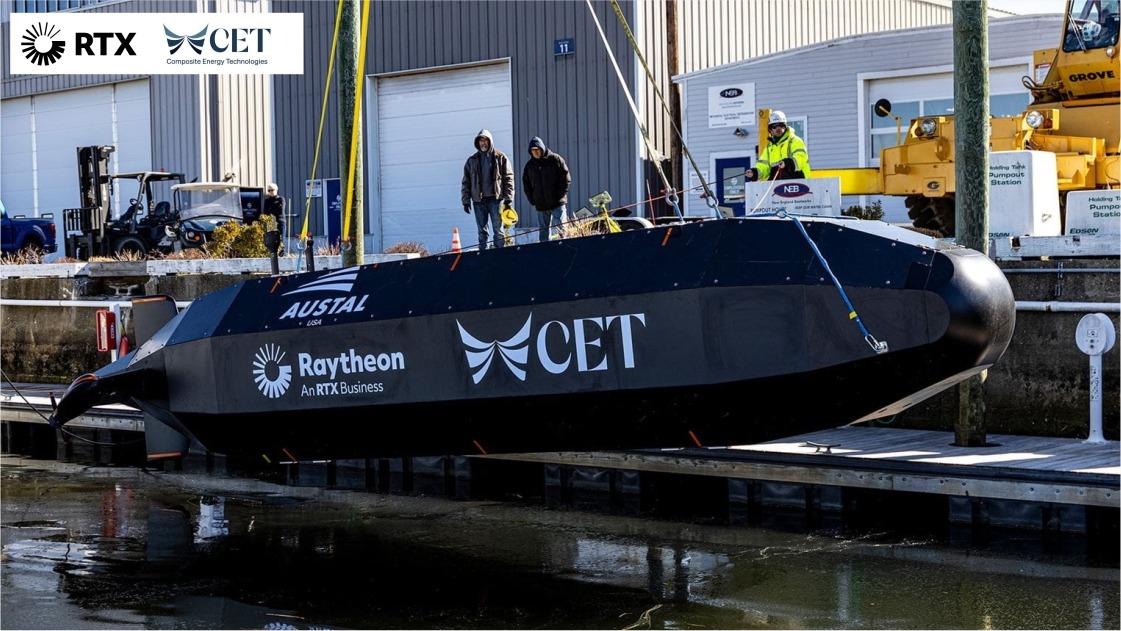
    Raytheon, an RTX business, and Composite Energy Technology (CET) have successfully demonstrated HADALUS, a new long-endurance unmanned underwater vehicle (UUV) designed to provide lower-cost autonomous capabilities for undersea missions.

    The demonstration marks a major milestone for the companies' collaboration, which progressed from an initial concept to a complete, water-tested prototype in less than 18 months. The effort combined CET's composite vehicle architecture with Raytheon's expertise in mission systems, sensors, integration, and underwater technologies.

    At the heart of HADALUS is a free-flooded exoskeleton made entirely from carbon fiber, providing the vehicle with a high-strength, lightweight structural architecture while creating additional capacity for mission payloads. The composite configuration is intended to support long-duration operations while reducing the cost and complexity associated with conventional UUV designs.

    HADALUS measures 34 feet in length, has a 6-foot cross section, and is designed to achieve an endurance of more than 2,000 nautical miles. Its architecture is also intended to make the vehicle substantially more affordable, with an estimated cost of approximately one-third to one-fifth that of comparable long-endurance underwater vehicles.

    The use of carbon fiber composites is central to the platform's design strategy. The material provides the strength and stiffness required for an undersea structure while enabling a lightweight architecture that can accommodate significant payload capacity. The simplified exoskeleton approach also contributes to the vehicle's targeted cost advantages and scalability.

    The prototype program included vehicle design and construction, integration of the launcher, sonar, and electronics, followed by comprehensive system testing before the at-sea demonstration.

    This demonstration is an important step in a broader roadmap to deliver autonomous, end-to-end undersea capabilities that are far less detectable than surface platforms, said Jen Gauthier, vice president of Naval Systems & Sustainment at Raytheon. By tightly coupling design, integration and at-sea experimentation, we've proven we can bring new autonomous solutions to the fleet quickly and cost-effectively.
    According to CET, the rapid development timeline demonstrates how advanced composite manufacturing can help accelerate the development of new undersea platforms. The company's composite architecture was combined with Raytheon's mission systems and integration capabilities to create a vehicle intended for scalable production.

    HADALUS demonstrates that the undersea industrial base can move with greater speed and dynamism than traditional development cycles allow, said Chase Hogoboom, CEO and president of CET. By combining CET's advanced composite vehicle architecture with Raytheon's mission systems, sensors and integration expertise, we have created a highly capable platform that can be produced at a fraction of the cost of conventional alternatives.

    The companies see HADALUS as part of a broader effort to develop autonomous, long-range undersea systems that can be deployed at greater scale. Its combination of carbon-fiber composite construction, long endurance, and significantly lower projected cost could provide a pathway toward more affordable unmanned undersea capabilities for future defense missions.

    Home News Raytheon and Composite Energy Technology Demonstrate Carbon-Fiber UUV for Long-Endurance Undersea Missions

    Raytheon and Composite Energy Technology Demonstrate Carbon-Fiber UUV for Long-Endurance Undersea Missions

    BY Composights

    Published: 12 Aug 2026

    Raytheon, an RTX business, and Composite Energy Technology (CET) have successfully demonstrated HADALUS, a new long-endurance unmanned underwater vehicle (UUV) designed to provide lower-cost autonomous capabilities for undersea missions.

    The demonstration marks a major milestone for the companies' collaboration, which progressed from an initial concept to a complete, water-tested prototype in less than 18 months. The effort combined CET's composite vehicle architecture with Raytheon's expertise in mission systems, sensors, integration, and underwater technologies.

    At the heart of HADALUS is a free-flooded exoskeleton made entirely from carbon fiber, providing the vehicle with a high-strength, lightweight structural architecture while creating additional capacity for mission payloads. The composite configuration is intended to support long-duration operations while reducing the cost and complexity associated with conventional UUV designs.

    HADALUS measures 34 feet in length, has a 6-foot cross section, and is designed to achieve an endurance of more than 2,000 nautical miles. Its architecture is also intended to make the vehicle substantially more affordable, with an estimated cost of approximately one-third to one-fifth that of comparable long-endurance underwater vehicles.

    The use of carbon fiber composites is central to the platform's design strategy. The material provides the strength and stiffness required for an undersea structure while enabling a lightweight architecture that can accommodate significant payload capacity. The simplified exoskeleton approach also contributes to the vehicle's targeted cost advantages and scalability.

    The prototype program included vehicle design and construction, integration of the launcher, sonar, and electronics, followed by comprehensive system testing before the at-sea demonstration.

    This demonstration is an important step in a broader roadmap to deliver autonomous, end-to-end undersea capabilities that are far less detectable than surface platforms, said Jen Gauthier, vice president of Naval Systems & Sustainment at Raytheon. By tightly coupling design, integration and at-sea experimentation, we've proven we can bring new autonomous solutions to the fleet quickly and cost-effectively.

    According to CET, the rapid development timeline demonstrates how advanced composite manufacturing can help accelerate the development of new undersea platforms. The company's composite architecture was combined with Raytheon's mission systems and integration capabilities to create a vehicle intended for scalable production.

    HADALUS demonstrates that the undersea industrial base can move with greater speed and dynamism than traditional development cycles allow, said Chase Hogoboom, CEO and president of CET. By combining CET's advanced composite vehicle architecture with Raytheon's mission systems, sensors and integration expertise, we have created a highly capable platform that can be produced at a fraction of the cost of conventional alternatives.

    The companies see HADALUS as part of a broader effort to develop autonomous, long-range undersea systems that can be deployed at greater scale. Its combination of carbon-fiber composite construction, long endurance, and significantly lower projected cost could provide a pathway toward more affordable unmanned undersea capabilities for future defense missions.