Dawn Aerospace Team Visits Oklahoma to Advance Historic Suborbital Space Partnership
BY Composights
Published: 14 Dec 2025


Reusable suborbital spaceflight is moving from concept to
cadence and advanced composite structures are at the core of that shift. Dawn Aerospace s partnership with the
Oklahoma Space Industry Development Authority (OSIDA) to deploy its Mk-II
Aurora runway-operated spaceplane underscores how lightweight, thermally
resilient composite materials are
enabling rapid reusability, aircraft-like turnaround times, and repeatable
access to microgravity environments.
Designed to reach the edge of space at around 100 km with
turnaround cycles measured in hours, Aurora represents a new materials-driven
architecture for high-frequency suborbital missions supporting aerospace,
materials science, and technology validation programs.
Under the US$17
million agreement between Dawn Aerospace and OSIDA within the ODAA, Dawn
Aerospace will:
- Deliver
a Mk-II Aurora rocket-powered, runway-operated spaceplane to the Oklahoma
Air and Space Port.
- Provide
ground support equipment, licensing support, training, and parts and
servicing to establish sustained operations.
- Support
a program of up to 100 Aurora missions in the first year, giving customers
reliable, high-cadence access to suborbital flights, enabling
experimentation, testing and refining technology, validating payloads, and
demonstrating capability at a cadence no one else can offer.
Aurora is designed to fly to altitudes of around 100 km, the
edge of space, with turnaround times of just a few hours. Its aircraft-like
operations and rapid reusability are intended to make suborbital spaceflight
more affordable, repeatable, and accessible for government, commercial, and
academic customers. The partnership will transform Burns Flat into the nation s
premier business suborbital spaceport, with aircraft delivery and the start of
full operations scheduled for 2027.
Dawn Aerospace sent a three-person delegation to Oklahoma to
advance operational planning and engage with key stakeholders across
government, regulators, industry, education, and the community. The visit
focused on infrastructure planning, partnership development, and ensuring
continued alignment as preparations for flight operations progress, as well as
exploring the opportunities the spaceplane program brings to the state.
The visit represents an important step in Oklahoma s goal
to establish itself as a hub for space technology development and testing, said Grayson Ardies, CEO of OSIDA and Executive Director of ODAA. This
is a crucial component for the next century of microgravity innovations in
aerospace, medical research, fluid dynamics, and materials science. Affordable
access to suborbital flights will facilitate significant breakthroughs with
tangible positive research outcomes across numerous platforms.
The Oklahoma Aerospace and Aeronautics Department's mission encompasses both the operation of OSIDA, the Oklahoma Air and Space Port, and the promotion of the state s broader space industry. Through partnerships such as this with Dawn Aerospace, Oklahoma is positioning itself as a central player in America s new generation of suborbital spaceflight initiatives.
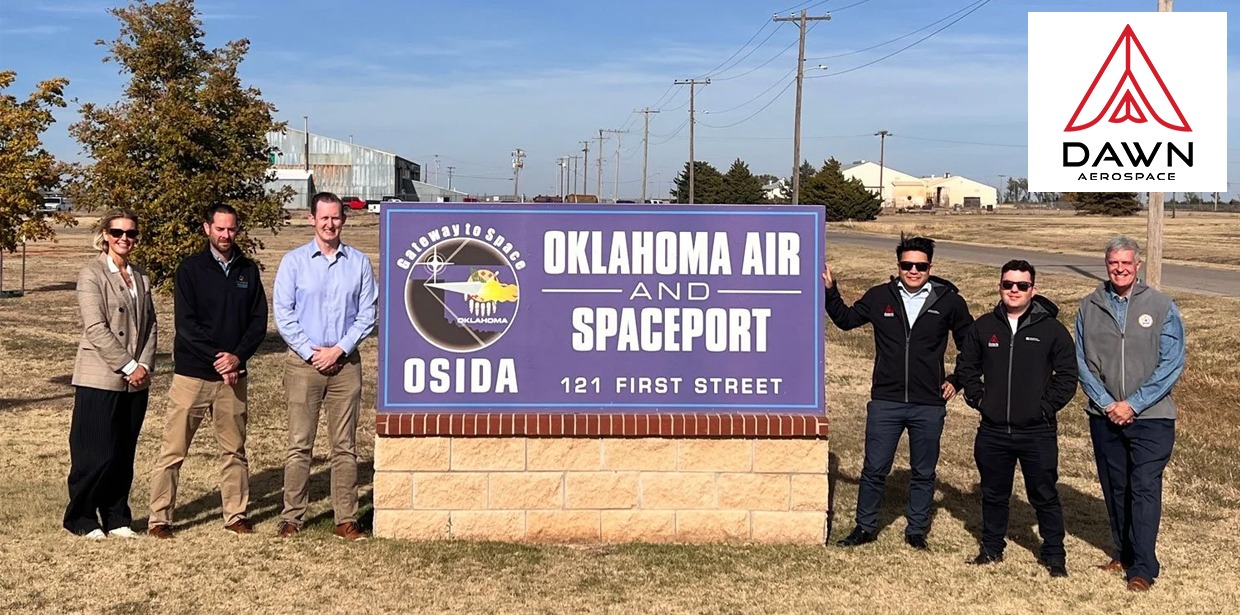
While in the state, the Dawn team also met with officials from ODAA and staff members working at the spaceport. The agenda included a community briefing and Q&A on November 12, followed by a legislative briefing with state officials at the Oklahoma State Capitol on November 13.
Oklahoma s aviation and aerospace sector is the state s second-largest and fastest-growing economic engine, with a rich heritage that now generates nearly $44 billion annually and supports more than 206,000 jobs (120,000 direct), with an average salary of US$73,300. The longstanding credibility of Oklahoma State s aerospace industry has enabled prioritisation of investment and development in the next era of spaceflight.
This partnership positions Dawn Aerospace at the forefront of a suborbital renaissance and revolution and also amplifies Oklahoma's broader statewide effort to grow a high-value aerospace and space economy, fostering high-tech jobs, unlocking education and research programs and payloads, investment into Oklahoma, and commercial space access for businesses nationwide.