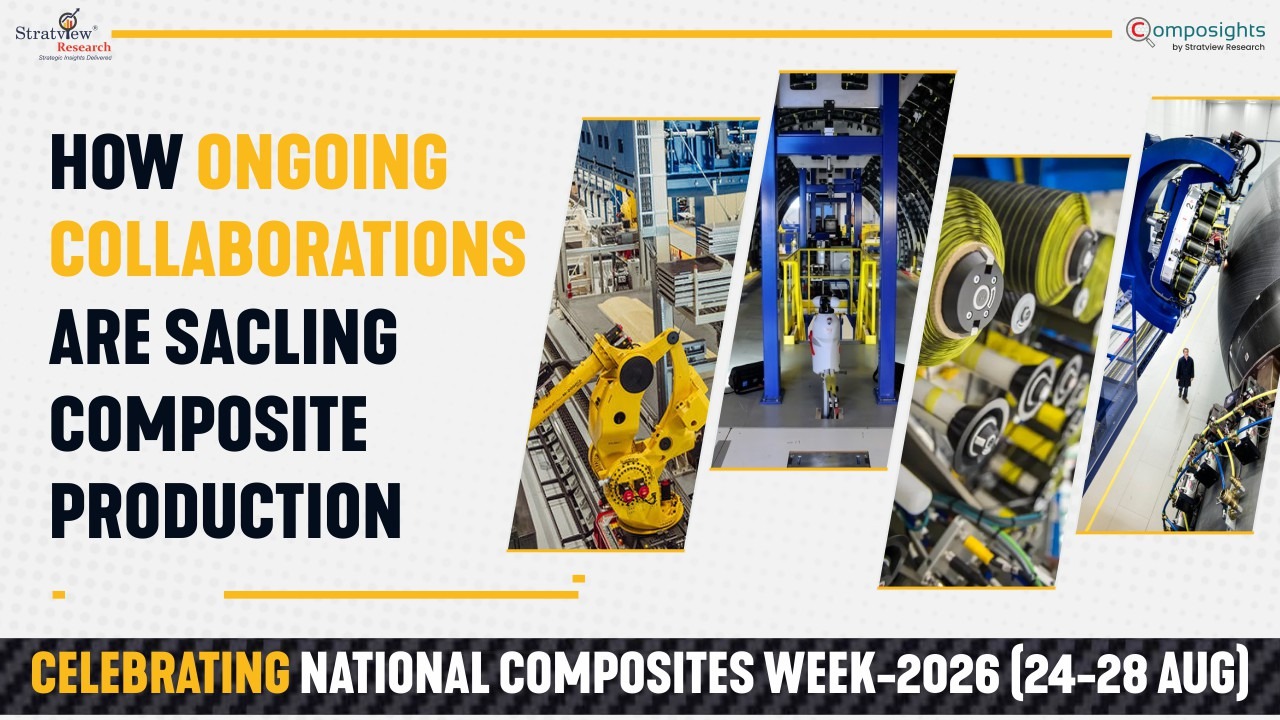
Over the past three days of our National Composites Week 2026 series, we have looked at processes designed for faster production, materials developed for shorter processing times, and the growing role of AI, automation and digital technologies in composite manufacturing. The same theme continues here: “Composites are Built to Scale”, but reaching higher production rates requires more than improving a single step in the manufacturing process.
Meeting the broader objective of taking composites to scale is not an individual play. Several industry collaborations are working in this direction to make composites scalable, affordable, and easy to process. For ex, COMPASS is targeting a major reduction in processing time for large composite structures. NASA's HiCAM programme is addressing the wider challenge of increasing composite aircraft production rates. Airbus's HEMERA programme is focused on manufacturing large CFRP fuselage panels at rates suited to higher-volume aircraft production.
Let's have a closer look at each of these programmes.
Cutting Process Time Roughly Tenfold with COMPASS
The COMPASS programme brings together Boeing's Isothermal High-Rate Sustainable Structures (IHSS) programme with the Advanced Manufacturing Research Centre (AMRC), Spirit AeroSystems, and Loop Technology to develop faster manufacturing methods for large composite structures.
A key target is to reduce processing time for a large composite part from around 40 hours to approximately 4 hours, representing a potential reduction of about 90%. The programme is supported by large-scale manufacturing infrastructure, including a 2,400-tonne RTM press, alongside automated and digital manufacturing technologies.
The focus is not limited to speeding up one operation. The programme combines tooling, resin transfer moulding, automation, robotics, and digital technologies to address the production cycle as a whole. For large composite structures, this system-level approach is important because increasing the speed of one stage can create a bottleneck elsewhere in the process.
Moving from 10–14 to 80 Aircraft a Month with NASA HiCAM
NASA's High-Rate Composite Aircraft Manufacturing (HiCAM) programme brings together 22 industry and academic partners to develop manufacturing technologies for large composite primary structures.
Its target is to increase composite aircraft production from the current range of 10–14 aircraft per month to 80 aircraft per month. The programme covers thermoplastic and thermoset composites, resin infusion, automated inspection, and digital engineering, addressing multiple stages of composite aircraft manufacturing.
The scale of this target requires more than faster individual processes. Materials, manufacturing equipment, inspection systems, tooling, and digital engineering all need to support higher production rates as part of the same manufacturing system.
Targeting 70+ Aircraft a Month with Airbus HEMERA
Airbus's HEMERA programme, running from 2025 to 2029, focuses on the manufacture of large, stringer-stiffened CFRP fuselage panels.
The programme covers continuous stringer production, automated lay-up, 3D preforms, co-curing, and in-process quality assurance. Its target is to support production rates of more than 70 aircraft per month.
At these production rates, increasing the speed of one manufacturing operation is not enough. Lay-up, forming, joining, curing, inspection, and quality control all need to work within a production system designed for higher throughput. HEMERA addresses these stages together.
What These Programmes Reveal About Scaling Composites
40 hours to around 4. 10–14 aircraft a month targeted toward 80. More than 70 aircraft a month targeted through HEMERA. Different programmes, different manufacturing challenges, but the direction is the same: higher composite production rates require faster processes, advanced materials, automation, digital systems, and the infrastructure to bring them together.
Taken together with the first three articles in this National Composites Week series, a clearer picture emerges. Process innovation shortens production time. Material innovation supports faster processing. AI and digital technologies improve automation and quality control. Collaboration brings these capabilities together at the scale required for industrial production. For an industry moving toward higher-volume composite manufacturing, the ability to align materials, processes, digital technologies, and manufacturing capacity may matter as much as any individual innovation.
Do follow our pages @Stratview Research and @Composights for regular insights on composites.
Wait for tomorrow to read our next piece in this National Composites Week series.
#NationalCompositesWeek #CompositesBuildToScale #Composites #CompositeManufacturing #AdvancedManufacturing

Samridhi Singh Sisodiya
Associate Content Writer
Samridhi is a content writer passionate about creating impactful digital content for the Mobility and Composites industries. She specializes in writing compelling blogs and social-media content, shaping industry insights into powerful stories that grow brand presence and connect with a broad range of audiences.
Newsletter
Subscribe for regular composites intelligence
The most trusted editorial picks and market signals on composites — straight to your inbox.