There are materials that merely perform, and there are materials that redefine what performance itself means. Composites have long belonged to the latter category. They're versatile materials with proven benefits: an exceptional strength-to-weight ratio, resistance to corrosion, design flexibility that rigid conventional materials can't match, and durability under conditions that would fatigue metals.
Yet this year, National Composites Week by CompositesWorld turns its attention to a different question, one implied by its theme, "Composites are built to scale": it is not enough for a material to be excellent in principle if it cannot be produced in the volumes the world now demands.
This is the story of that gap, and of the industry racing to close it.
Scale Can’t Wait
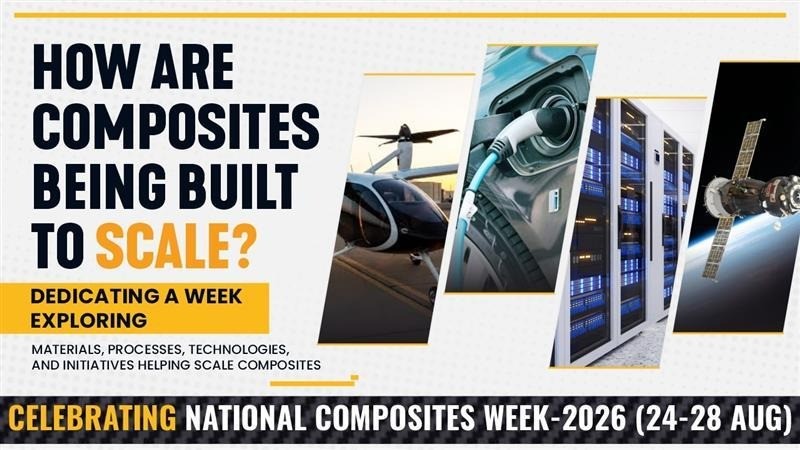
New applications for composites are emerging across industries, and they're set to create a demand pull the current manufacturing base isn't yet built to absorb. Automotive (especially EVs), space, data centers, and aerospace (including eVTOL, UAM, and drones) are among the clearest examples of this pull already taking shape.
Look at the case of EVs, for instance. The IEA reports global EV sales topped 21 million units in 2025, up 20% year-on-year and accounting for a quarter of all new car sales worldwide, with the global fleet projected to reach as many as 510 million by 2035, when EVs could account for about half of all car sales globally. EVs have driven a demand of nearly 1,700 KTs for composite materials in 2025 and this number is going to rise significantly with the meteoric rise in EV sales in the coming decade. The automakers are turning to composites specifically to offset battery weight, and that demand curve alone would strain current capacity.
Aviation tells a similar story, and from both ends at once: the global commercial aircraft order backlog has reached a record high of more than 15,000 unfilled jets, with Boeing and Airbus projecting over 43,000 deliveries by 2040, even as NASA - National Aeronautics and Space Administration's Hi-Rate Composite Aircraft Manufacturing (HiCAM) program notes that aircraft built primarily from composite materials are produced at roughly 10 to 14 a month, versus 60 a month for comparable aluminum airframes. Its stated goal is 80 a month, a roughly sixfold jump. Urban air mobility adds a newer version of the same pressure: eVTOL composites represent a >USD 3,200 million opportunity by 2040 with north of 2,000 units being manufactured annually, and that’s too as per a conservative estimate considering the challenges for their take-off in the market.
Space composites (mainly prepregs) represent a >USD 250 million opportunity in 2026 alone, as satellite constellations and reusable launch vehicles increasingly depend on composite structures for payload efficiency and lower launch costs.
Data center composites, meanwhile, are a >USD 70 million opportunity in 2026, as AI-driven computing pushes facilities toward denser racks and higher heat loads, making materials like fiberglass-reinforced plastic a preferred choice for server enclosures, cable trays, and structural components.
And these are just few examples, the demand is building across multiple industries at once, each pushing composites toward volumes well beyond current manufacturing feasibility.
Closing the Gap: Materials
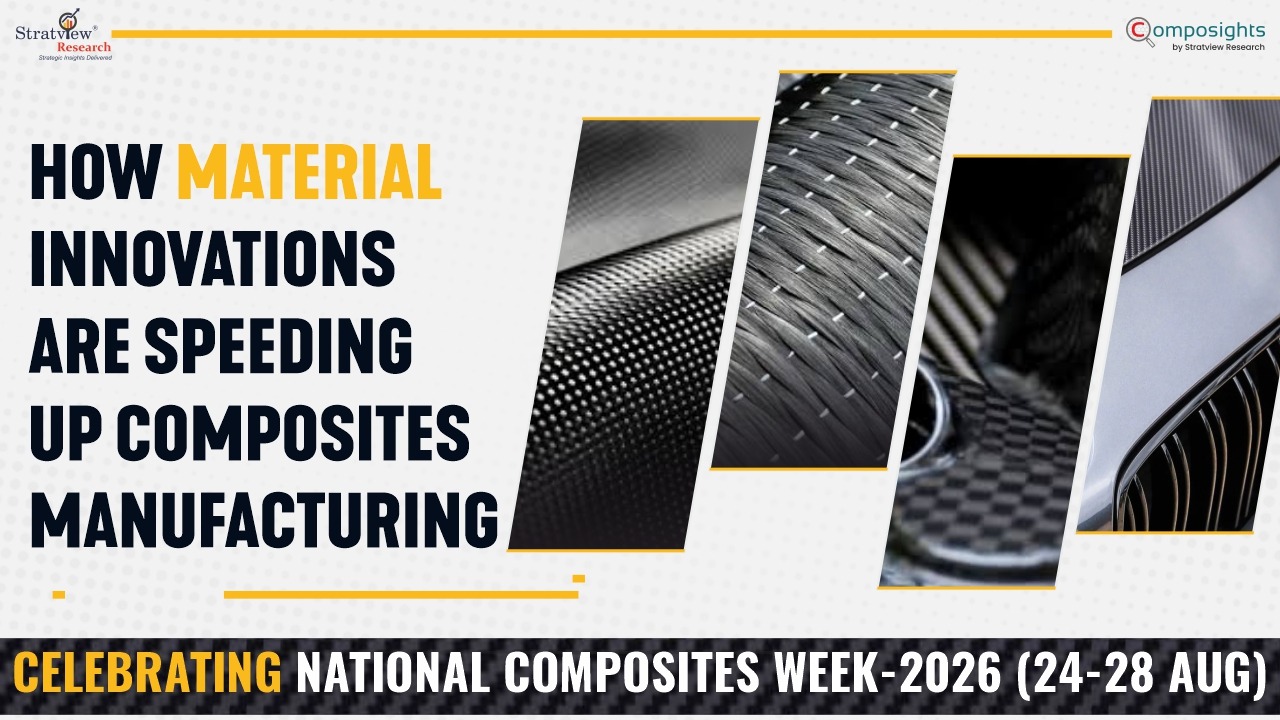
Parts of that gap are already closing now. On the materials front, resin chemistry and molding technique are closing the speed gap between thermosets and thermoplastics.
From 60-minute cycle time to under 10 minutes through HP-RTM: Standard low-pressure resin transfer molding (RTM) runs a 30 to 60-minute cycle; high-pressure RTM (HP-RTM) cuts that to under 10 minutes, and in some cases below two. BMW Group proved the throughput case early, using HP-RTM for the carbon fiber roofs and structural components on its i3 and i8.
Hexcel’s rapid-cure CF Preform: Hexcel has since pushed further with a rapid-cure carbon-fiber preform for the BMW 7 Series B-pillar that cures in just 1.5 minutes, with its automated line capable of producing preforms for up to 500 cars a day.
>200,000 parts manufactured per year using Organosheet: Continuous fiber-reinforced thermoplastic sheets, known as organosheet, have gone further still, with production demonstrated at more than 200,000 parts a year from a single manufacturing line.
FACC’s Fast-curing prepregs: In aerospace, FACC AG has pointed to fast-curing prepregs cutting curing time by up to 90%, and Airbus has installed what it calls the world's largest thermoplastic composite press at its Bremen facility; thermoplastics skip curing altogether.
Closing the Gap: Process
On the process front, similar gains are showing up in how composite parts get made, not just what they're made of.
Airbus's HEMERA project - automated high-rate fuselage production: A consortium with Fraunhofer and the German Aerospace Center (DLR) is developing automated, high-rate methods for producing CFRP fuselage skin and stringer panels, aimed at production rates above 70 aircraft a month.
Automated dry-fibre preforming for the A350: Airbus has also automated dry-fibre preform production for the A350 fuselage with partner Airborne, replacing hand layup with machine vision and automated cutting.
KraussMaffei's FiberForm process - ~3,000x faster than metal: Combining thermoforming and injection molding, FiberForm produces a composite part in around two minutes, versus 100-plus hours for a comparable metal component.
Out-of-autoclave processes on the horizon: Both major airframers are exploring out-of-autoclave methods, including thermoplastic welding, to compress assembly time further.
Analysts still place full high-rate readiness roughly a decade away - this is a live transition, not a finished one.
Closing the Gap: Technology
On the technology front, AI is addressing a different part of the scaling problem - not how fast a part is made, but how much of that speed survives to the finished part.
Virtek's Iris AI Composite Inspection — defects caught in under 3 seconds: Shown at CAMX 2026, the system uses edge-processing cameras to catch defects like foreign object debris in real time, rather than at final QC.
Olmar's OCS software - real-time cure monitoring: Applying the same logic to curing, OCS uses automated recipe programming to catch process deviations as they happen.
IMDEA/UPM's digital twin - resin flow predicted in under 50 milliseconds: Researchers at IMDEA Materials and the Technical University of Madrid have built a digital twin for resin transfer molding that predicts resin flow inside the mold fast enough to catch a defect while it's still forming, rather than after the part is done.
None of these tools build parts faster, they stop faster manufacturing from being undone by defects caught too late.
Follow the Rest of the Week
What this year's National Composites Week theme, "Composites are built to scale," puts forward is whether they can be made fast enough, consistently enough, and in high enough volume to meet the demand already arriving from automotive, aviation, and beyond.
As this piece has shown, the industry is actively working on this front: materials are curing faster, processes are shedding manual steps, and AI is closing the gap between speed and quality rather than letting one come at the cost of the other. However, this article is only a snapshot. Through National Composites Week (August 24–28), we'll be unpacking the materials, processes, technologies, and companies driving this shift in more detail, every day, on our social platforms.
Follow along the pages Stratview Research & Composights (by Stratview Research) this week as we go deeper on each.
Authored by Stratview Research. Also published on – Stratview Research | Linkedin

Chandana Patnaik
Senior Strategist (Content)
Chandana Patnaik is a Senior Content Strategist at Stratview Research, specializing in composites, aerospace, defense, mobility, and emerging industrial technologies. She translates complex concepts and market intelligence into insightful, reader-focused content for industry professionals, helping business leaders understand technology trends, competitive landscapes, and future market opportunities.
Newsletter
Subscribe for regular composites intelligence
The most trusted editorial picks and market signals on composites — straight to your inbox.