For composites, the production challenge is increasingly becoming a question of time.
A part that takes weeks to lay up, hours to cure, or too much manual effort to reproduce consistently may work perfectly well from a performance standpoint. But when hundreds or thousands of units are required, the manufacturing process becomes the constraint.
The next decade will see increased composites demand from emerging applications, such as EVs, Data Centers, Space, and UAM. And the composites industry is mustering efforts on all fronts: Processes, Materials, New Age Technologies and collaborations.
And this year's National Composites Week's theme "Composites are Built to Scale" fits well here. In our first piece today, we will explore what work around scaling composites is happening on the factory floor with some real examples.
Established processes are getting faster and more automated, while newer approaches are combining manufacturing steps that once had to be carried out separately. And in several cases, the difference is being measured in hours, minutes, and even seconds.
Taking the Handout of Layup
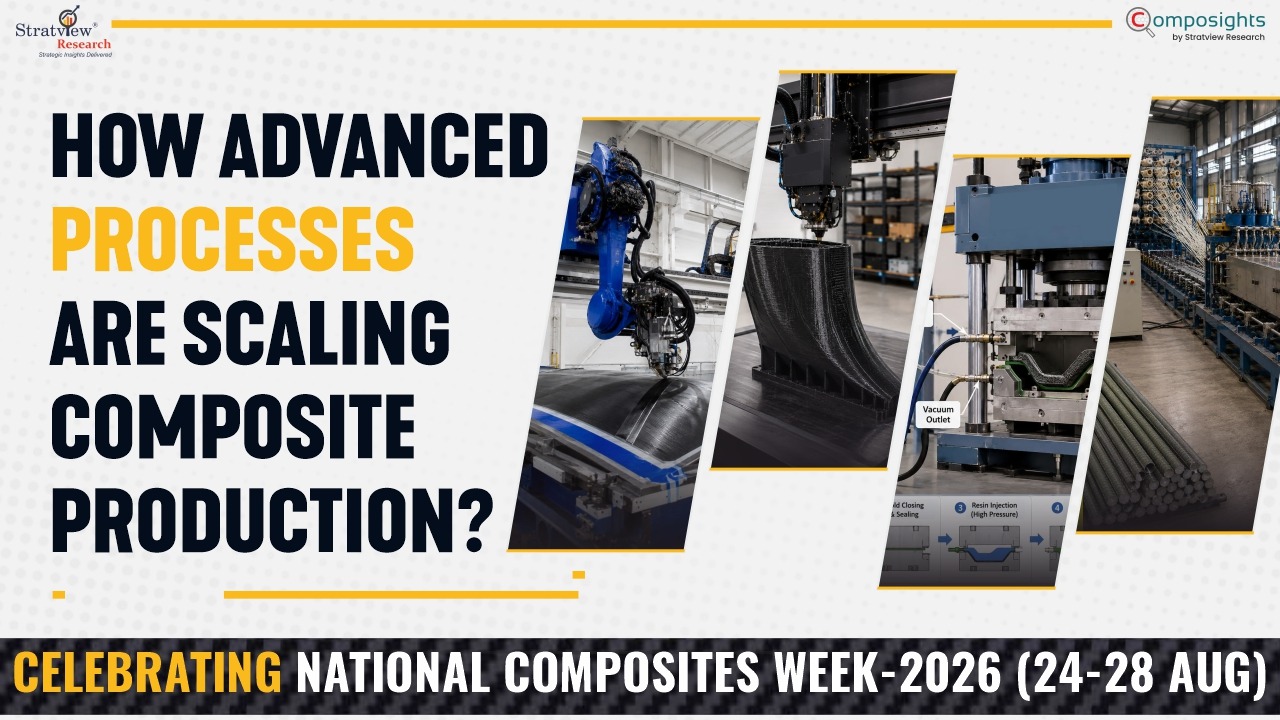
Automated Fiber Placement (AFP) addresses one of the most obvious places to start: manual layup.
Instead of workers placing composite material by hand, AFP places continuous tapes or tows along programmed paths, maintaining precise fiber orientation while building the structure. AFP can reach 10–150 kg/hour compared with 2–3 kg/hour for traditional hand layup – up to 40× faster.
Here are other benefits –
Reduces material waste by up to 88%,
Lowers labor requirements by up to 80%, and
Delivers 2× better repeatability.
Rocket Lab offers a useful indication of what those numbers can mean on an actual production floor. For composite structures on its Neutron rocket, the company shifted from manual layup to AFP. Key structures that previously took weeks to manufacture can now be produced in approximately 24 hours. When production moves from weeks to a day, the economics and production planning around a large composite structure begin to look very different.
3D Printing is Cutting the Time Before Production Too
Not every production bottleneck sits in the composite part itself. Tooling can consume weeks before manufacturing even begins. 3D printing has changed that equation by building parts or tooling layer by layer directly from a digital design, eliminating some of the machining associated with conventional manufacturing. Depending on the application, it can deliver up to 85% shorter production time and up to 90% lower material consumption, while making complex geometries and customized tooling easier to produce.
SUBARU demonstrated the impact using Stratasys' F770 3D printer with the T25 high-speed print head. The company reduced tooling development from weeks to days, while cutting costs by approximately 70%.
That matters because scaling production is not only about how quickly a final component comes out of the mold. The tooling, fixtures, and supporting manufacturing infrastructure have to keep pace as well.
From 30–60 Minutes to Under 10: RTM Gets Faster
Resin Transfer Molding (RTM) has long provided a closed-mold route for producing composite parts by injecting resin into a dry-fiber preform. But conventional RTM cycle times can become restrictive as volumes increase.
HP-RTM tackles that limitation with higher injection pressure. Where conventional RTM operates at around 10–20 bar, HP-RTM can reach up to 150 bar, accelerating resin impregnation and mold filling. The result is a reduction in cycle time from 30–60 minutes to less than 10 minutes, alongside greater automation and process repeatability.
Bucci Composites (formerly Riba Composites) is already putting that speed into production. Using Cannon's HP-RTM and press-molding technology for structural automotive and aerospace components, its line achieves resin injection in under 30 seconds and cure times of 90 seconds to three minutes.
This is where cycle-time reductions start becoming more than an impressive process metric. Cutting tens of minutes from every production cycle compounds across a manufacturing line, opening the door to considerably higher throughput from the same process family.
What Happens When Processes Start Combining?
Beyond improving established processes, another route to scale is emerging: combine multiple manufacturing operations into one automated cycle.
KraussMaffei's FiberForm technology provides an outstanding example. It was demonstrated on a complex thermoplastic eVTOL rib in collaboration with NIAR. The process combines continuous-fiber thermoplastic thermoforming and injection overmolding in a single automated cycle. The manufacturing time dropped from >100 hours to <2 minutes – approximately 3,000× faster than conventional metal manufacturing.
The opportunity is not always to make an existing process slightly faster. In some applications, redesigning the manufacturing route itself can remove entire stages from production.
Oak Ridge National Laboratory's Additive Manufacturing Compression Molding (AMCM) follows a similar logic from another direction. AMCM combines additive manufacturing and compression molding, using short-fiber-filled polymer and continuous fiber printed directly onto a mold with precise orientation. The process demonstrated 100 parts produced in 5 hours, with less than 3 minutes of printing per part.
Again, the important number is not simply how quickly something can be printed. It is what happens when 3d printing becomes part of a production process capable of repeatedly turning out finished composite components.
Faster Doesn't Have to Mean Simpler Geometry
Manufacturing speed may improve, but the freedom to place fibers exactly where structural performance demands them can become harder to retain. ICOMAT's Rapid Tow Shearing (RTS) approaches that problem differently. Its patented automated process uses in-plane shear to steer wide carbon-fiber tapes along complex curved paths without defects. ICOMAT describes RTS as the world's first defect-free fiber-steering technology, with 10× faster production compared with conventional methods.
The technology has already been demonstrated on a Jaguar Land Rover SUV rear header, achieving ~30% weight reduction, and an Airbus × BAE Systems lower wing skin, with ~65% weight reduction.
That combination is important. Scaling composites cannot simply mean producing parts faster if doing so removes the design advantages that made composites attractive in the first place. The process has to bring manufacturing rate and structural optimization closer together.
And Sometimes, Scale Means Not Stopping
Pultrusion takes a different route altogether.
Rather than repeatedly starting and stopping individual molding cycles, the process supports continuous production by controlling fiber feeding, resin flow, and curing as material moves through the line. GatorBar demonstrated just how much throughput that can produce: >200,000 ft of 10 mm composite rebar in 11 hours on a single production line.
That works out to approximately 304 ft of composite rebar every minute.
For applications such as composite rebar, that continuous-production model addresses scale in perhaps its most literal form: keep the process running while maintaining consistent quality.
The Process is Becoming Part of the Performance Equation
These processes are very different, but the direction is remarkably consistent – and it reflects the focus of National Composites Week 2026: Composites Built to Scale.
Less manual work.
Fewer separate manufacturing steps.
Shorter cycles.
Higher throughput.
Greater repeatability.
Automation is becoming central to that shift. By reducing labor-intensive tasks, integrating more stages of production, and making processes easier to control and repeat, manufacturers can move composites beyond low-volume, highly specialized applications and toward more consistent, scalable output.
For an industry trying to move composites into applications that demand production at a very different scale, those gains are becoming just as important as strength, weight, durability, or design freedom. The real opportunity for composites, then, lies in how easily, consistently, and efficiently we can manufacture them at scale.
Do follow our pages @Stratview Research and @Composights for regular interesting content on composites.
Wait for tomorrow to read our next piece on material innovations.
#NationalCompositesWeek #CompositesBuildToScale #Composites #CompositeManufacturing #AdvancedManufacturinga

Shivani Chimnani
SEO Content Writer Associate
Shivani is a content writer with passion for crafting engaging digital content across the Mobility and Composites industries. She creates compelling blogs and social-media content, translating industry insights into impactful narratives that strengthen brand presence and connect with diverse audiences.
Newsletter
Subscribe for regular composites intelligence
The most trusted editorial picks and market signals on composites — straight to your inbox.