• Article
  • News
  • About us
  • Contact us
  • Dashboard
  • Home News NCC Demonstrates UK’s First All-Composites Linerless Propellant Tank for Space Applications

    NCC Demonstrates UK’s First All-Composites Linerless Propellant Tank for Space Applications

    BY Composights

    Published: 05 Sep 2025

    Tags:

    Linerless Propellant Tank | Type 5 Composite Pressure Vessels | epoxy prepreg |

    The National Composites Centre (NCC), with industry guidance from Thales Alenia Space, has successfully manufactured and tested an all-composites linerless (Type V) tank demonstrator for launch vehicles and satellites. The innovation is estimated to deliver a 30% weight saving compared to conventional metallic tanks, directly addressing the space industry s drive to reduce launch costs.

    The SpaceTank project, a one-year initiative, set out to develop UK-based tools for the manufacture and inspection of composite pressure vessels. With a global launch market where every kilogram saved translates to thousands of pounds in cost savings, NCC s work positions the UK as a competitive player in the rapidly evolving space propulsion supply chain.

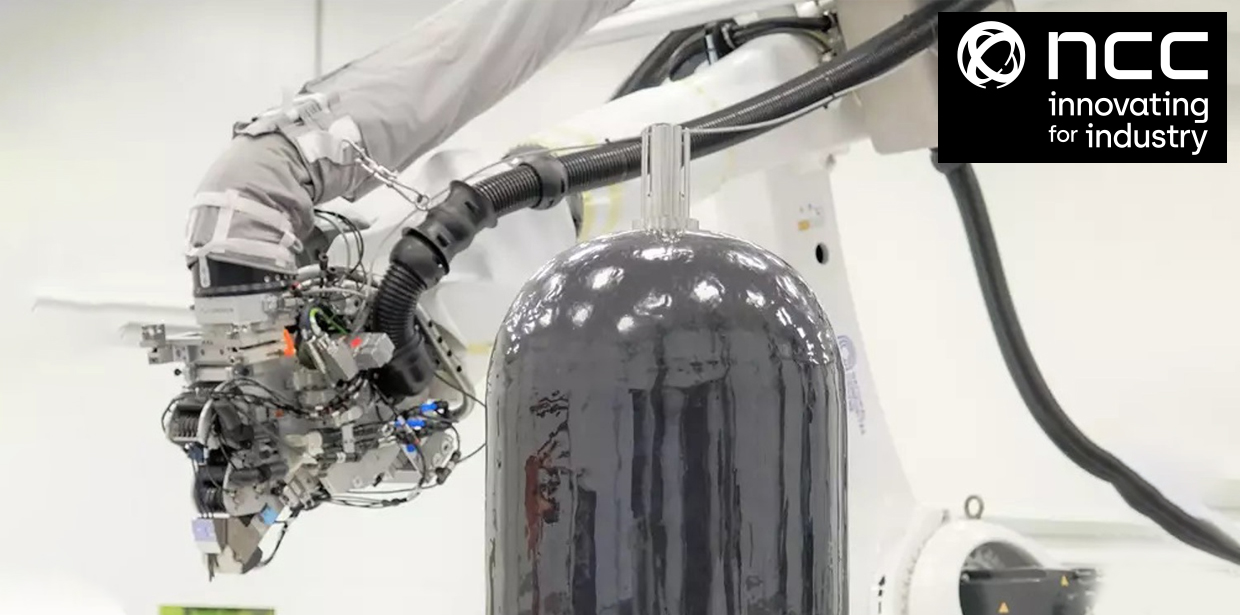
    The demonstrator tank, measuring 750mm in length with a 450mm diameter and a 96-litre storage capacity, was produced using MTC510 epoxy carbon prepreg supplied by SHD Composites and processed through Coriolis Automated Fibre Placement (AFP) technology. The resulting carbon composite structure weighs just 8kg, while still being capable of withstanding pressures of up to 85 bar.

    In partnership with AeroConsultants, NCC also pioneered a washable tooling solution using a water-soluble core material, which enabled integrated metallic valve ports without secondary assembly. The tank underwent rigorous non-destructive testing (NDT) including ultrasonic C-scanning and thermography, validating its structural integrity.

    This achievement builds on international momentum, with companies like Virgin Orbit (USA), Rocket Lab (New Zealand), MT Aerospace (Germany), and Omni Tanker (Australia) also exploring composite propellant tanks. NCC s success now provides the UK with a research foundation to support the growth of domestic space propulsion capabilities.

    Lightweight fuel tanks and systems will be an important contributor to future SABRE-powered vehicles. NCC s SpaceTank demonstrates the potential benefits of composites for space applications. Richard Varvill, CTO, Reaction Engines

    Composite tanks drastically reduce the cost and weight for future satellite systems. NCC s work enhances our performance capabilities, supporting governments and institutions worldwide. Roger Ward, CTO, Thales Alenia Space

    With the global space economy expanding, NCC s SpaceTank initiative represents a pivotal step in establishing a UK supply chain for advanced composite tanks, enhancing competitiveness in launchers and satellite propulsion.

    Source: www.nccuk.com

    Home News NCC Demonstrates UK’s First All-Composites Linerless Propellant Tank for Space Applications

    NCC Demonstrates UK’s First All-Composites Linerless Propellant Tank for Space Applications

    BY Composights

    Published: 05 Sep 2025

    The National Composites Centre (NCC), with industry guidance from Thales Alenia Space, has successfully manufactured and tested an all-composites linerless (Type V) tank demonstrator for launch vehicles and satellites. The innovation is estimated to deliver a 30% weight saving compared to conventional metallic tanks, directly addressing the space industry s drive to reduce launch costs.

    The SpaceTank project, a one-year initiative, set out to develop UK-based tools for the manufacture and inspection of composite pressure vessels. With a global launch market where every kilogram saved translates to thousands of pounds in cost savings, NCC s work positions the UK as a competitive player in the rapidly evolving space propulsion supply chain.

    The demonstrator tank, measuring 750mm in length with a 450mm diameter and a 96-litre storage capacity, was produced using MTC510 epoxy carbon prepreg supplied by SHD Composites and processed through Coriolis Automated Fibre Placement (AFP) technology. The resulting carbon composite structure weighs just 8kg, while still being capable of withstanding pressures of up to 85 bar.

    In partnership with AeroConsultants, NCC also pioneered a washable tooling solution using a water-soluble core material, which enabled integrated metallic valve ports without secondary assembly. The tank underwent rigorous non-destructive testing (NDT) including ultrasonic C-scanning and thermography, validating its structural integrity.
    This achievement builds on international momentum, with companies like Virgin Orbit (USA), Rocket Lab (New Zealand), MT Aerospace (Germany), and Omni Tanker (Australia) also exploring composite propellant tanks. NCC s success now provides the UK with a research foundation to support the growth of domestic space propulsion capabilities.

    Lightweight fuel tanks and systems will be an important contributor to future SABRE-powered vehicles. NCC s SpaceTank demonstrates the potential benefits of composites for space applications. Richard Varvill, CTO, Reaction Engines

    Composite tanks drastically reduce the cost and weight for future satellite systems. NCC s work enhances our performance capabilities, supporting governments and institutions worldwide. Roger Ward, CTO, Thales Alenia Space

    With the global space economy expanding, NCC s SpaceTank initiative represents a pivotal step in establishing a UK supply chain for advanced composite tanks, enhancing competitiveness in launchers and satellite propulsion.

    Source: www.nccuk.com