

Modern aerospace owes much of its composite revolution to thermosets. Carbon fiber pre-impregnated with resin is laid up by hand or robot and cured for hours in an autoclave under heat and pressure. This manufacturing approach enabled aircraft such as the Boeing 787 and Airbus A350 to achieve structures that are nearly 20% to 30% lighter and far more fuel-efficient than their aluminum equivalents.
But It Also Created A Manufacturing Bottleneck.
Autoclave processing is expensive, capital-intensive, and imposes a hard constraint on production rates. More importantly, thermoset parts cannot be welded, reformed, or recycled without significant energy input and material loss. As sustainability regulations tighten, the end-of-life fate of thermoset composites — largely landfill or incineration — is also emerging as a procurement concern.
That is why thermoplastic composites (TPCs) are gaining renewed industrial attention. Unlike thermosets, thermoplastic systems can be welded, processed in minutes rather than hours, and integrated into highly automated production lines. Today, the Boeing 787 uses about 150 thermoplastic shear webs to reinforce fuselage frames, while the Airbus A350 XWB incorporates approximately 8,000 TPC clips and cleats. The 787 goes even further, with 10,000 to 15,000 thermoplastic clips and cleats per aircraft.
As aerospace and defense manufacturers prepare for a new generation of lightweight, high-performance aircraft, thermoplastic composites are moving beyond demonstrator programs into production planning. The question is — how far can their adoption extend across future aircraft structures?
From Niche Components To Structural Applications
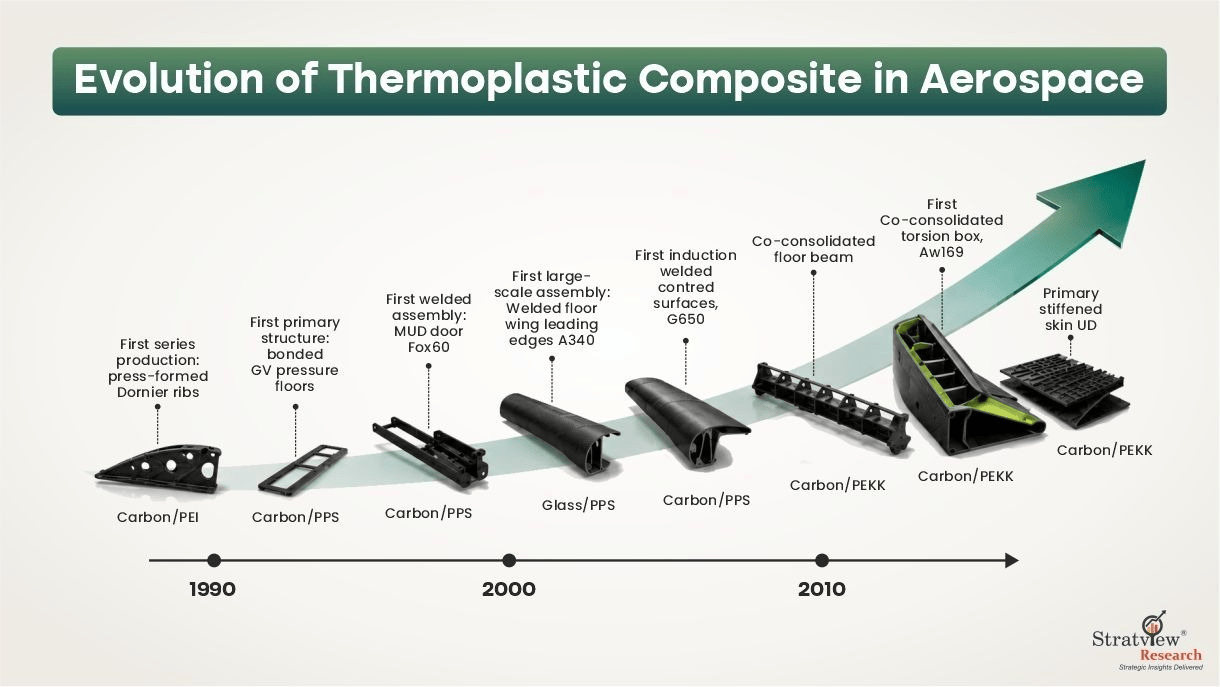
Although thermoplastic composites (TPCs) have become a major focus of aerospace manufacturing only in recent years, their journey began more than four decades ago. Their earliest applications date back to the US military's F-22 fighter, where TPCs were used in landing-gear and weapons-bay doors in the 1980s, followed by the outer wing trailing-edge skin panel (shroud) of the Fokker 50 passenger aircraft in the 1990s.
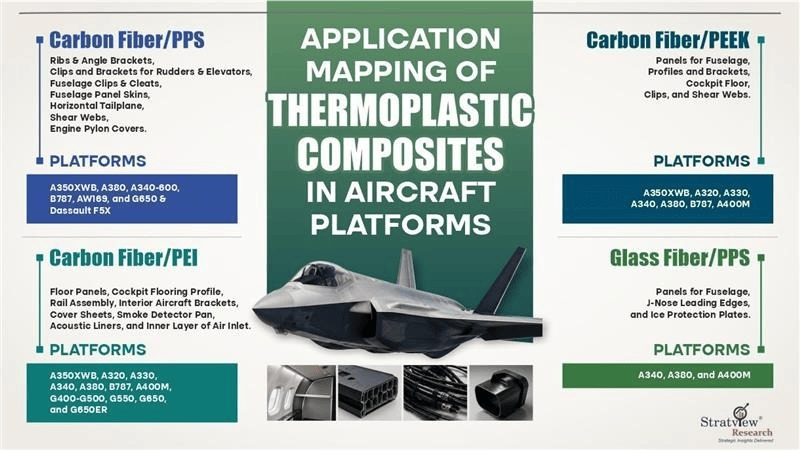
Fig.2, Thermoplastic composites are used in aircraft for panels, brackets, clips, flooring, seats, and interior components
Their adoption, however, remained gradual. Limited processing capability, certification challenges, and the aerospace industry's reliance on proven thermoset composites confined TPCs largely to secondary structures for many years. As material systems, manufacturing technologies, and design confidence advanced, their role expanded beyond non-critical parts.
Today, TPCs are used across a broad range of aircraft components, including clips, cleats, fixed-wing and J-nose leading edges, fuselage panels, profiles and brackets, ribs, control surface components, seat backs, window panels, and cockpit floors. Among these, clips and cleats remain the largest application segment, typically manufactured using carbon fiber reinforced with PPS or PEEK resins. This steady progression from secondary components to increasingly structural applications reflects the growing maturity of thermoplastic composites within modern aerospace programs.
The Production-Rate Imperative Behind Thermoplastic Adoption
Commercial aviation is entering one of its largest production ramps in decades. Global aircraft backlogs now exceed 17,000 units, while defense programs continue advancing next-generation aircraft, unmanned systems, and advanced air mobility platforms. Together, these trends are increasing pressure on manufacturers to deliver lighter, more complex aircraft at production rates that conventional autoclave-cured composite manufacturing struggles to support economically.
The scale of this challenge is evident in current industrial throughput targets. Airbus is progressing toward producing 75 A320 Family aircraft per month by 2027, while Boeing is targeting 70 Boeing 737 MAX aircraft per month. Together, these rates translate to nearly 1,750 narrowbody aircraft annually.
However, widebody, regional jets, and turboprops remain heavily skewed due to fleet size differences. According to May 2026 production data, manufacturers delivered 98 narrowbody aircraft, compared with just 20 widebody aircraft. In other words, narrowbody assembly rate was nearly five times higher than widebody output. Regional jets and turboprop aircraft represented an even smaller share, with only four aircraft produced in each category during the month.
With backlogs nearly 10 times larger than annual production, industry experts estimate that it might take more than 12 years to clear at current rates of manufacturing scale.
Airbus's Multifunctional Fuselage Demonstrator (MFFD) provides perhaps the strongest evidence that production rate — not just weight reduction — is driving thermoplastic adoption. Built under the Clean Sky 2 program, the carbon-fiber-reinforced thermoplastic fuselage demonstrator combines robotic ultrasonic welding with a rivet-free assembly approach, targeting more than 10% structural weight savings while supporting manufacturing output of around 100 fuselage sections per month — a figure aligned with the output required for future single-aisle aircraft programs.
Such factory capacity exposes the limitations of conventional thermoset composites. TPCs offer a fundamentally different manufacturing route. Instead of permanently cross-linking during curing, high-performance polymers such as PEEK (polyetheretherketone) or PEKK (polyetherketoneketone) reinforced with carbon fiber soften when heated and solidify upon cooling, enabling rapid processing, welding, and automated manufacturing. As a result, manufacturing cycle times can be reduced by as much as 80% compared with conventional materials.
For the aerospace and defense industry preparing for future production rates that could exceed 100 aircraft per month, manufacturing efficiency is becoming as critical as mechanical performance. In that environment, thermoplastic composites are emerging not simply as an alternative material system but as an enabler of higher-rate aircraft production.
Why Carbon Fiber Leads Thermoplastic Adoption
Among the various thermoplastic composite systems, carbon fiber reinforced thermoplastics (CFRTPs) have emerged as the preferred material system for aerospace and defense applications, combining the high specific strength and stiffness of carbon fiber with the manufacturing advantages of thermoplastic matrices. High-performance resins such as polyphenylene sulfide (PPS), polyetheretherketone (PEEK), polyetherketoneketone (PEKK), and polyetherimide (PEI) are processed with carbon, glass, or aramid fibers into laminates, unidirectional tapes, and fabric prepregs. While glass fiber continues to serve cost-sensitive interior and secondary applications, carbon fiber's superior stiffness-to-weight ratio makes it the reinforcement of choice for weight-critical aircraft structures.
The preference for CFRTP is evident across both commercial and military platforms. The Lockheed Martin F-35 Lightning II — the world's most widely operated fifth-generation combat aircraft — contains approximately 35% composite materials by weight, integrating advanced structural thermoplastics, nanocomposites, and carbon fiber reinforced polymer (CFRP) in its outer skin, airframe structures, flight control surfaces, and wingtip fairings.
Commercial aircraft follow the same trend. An Airbus A380 and a Boeing 787 each incorporate approximately 35 tons of carbon composites, while the Airbus A350 XWB increases that figure to about 65 tons, underscoring the aerospace industry's growing reliance on carbon fiber-based composite structures for next-generation aircraft.
Benefits, Bottlenecks, And Beyond
TPCs combine excellent weight reduction with a high strength-to-weight ratio, high tensile and compressive strength, low coefficient of thermal expansion, and superior fatigue resistance. These performance advantages, however, come at a premium. A TPC part typically costs at least twice as much as an equivalent metal part, creating significant cost implications for OEMs and tier suppliers.
Although glass fiber offers a more economical alternative, it falls short of carbon fiber in mechanical performance. Consequently, carbon fiber accounts for more than 90% of thermoplastic composite applications in aerospace and defense, where structural performance outweighs cost, while glass fiber remains largely confined to secondary and non-critical structures.
Despite their advantages, TPCs have their own manufacturing challenges. The high viscosity of molten thermoplastic resins makes it difficult to fully impregnate continuous carbon fiber bundles, potentially creating voids, dry spots, and poor fiber-matrix bonding that reduce mechanical performance. The same challenge extends to large-format 3D printing with continuous carbon fiber reinforcement, where achieving consistent impregnation and interfacial bonding continues to limit wider adoption.
The industry is steadily addressing these challenges. Companies such as Hexcel, Stratasys, and Markforged have developed solutions through in-situ consolidation, heated compaction rollers, improved nozzle designs, and related process innovations. In aerospace, however, this challenge is largely overcome in automated fiber placement (AFP) and automated tape laying (ATL) through the use of pre-impregnated unidirectional (UD) tapes manufactured under tightly controlled conditions.
Beyond technical barriers, industry conservatism continues to slow adoption. Thermoset composites themselves required three to four decades to become mainstream in aerospace, and TPCs are following a similarly gradual path toward broader acceptance.
At present, the global aerospace and defense thermoplastic composites market was valued at approximately $554 million in 2025. Despite its strong growth trajectory, TPCs still represent only a fraction of overall composite consumption by the aerospace and defense sector, accounting for merely 2% of total composite usage, and the aerospace and defense composites market itself represents less than 1% of the global composites market by volume.
Positioned For The Next Phase Of Aerospace And Defense Manufacturing
The aerospace and defense industry is entering a period where manufacturing capability is becoming as important as material performance. Rising aircraft backlogs, ambitious production targets, sustainability commitments, and defense modernization programs are collectively reshaping how future aircraft will be designed and built. Materials that can support faster manufacturing, greater automation, and improved end-of-life management are no longer optional — they are becoming strategic enablers.
TPCs align closely with these evolving requirements. Their weldability, repairability, recyclability, and compatibility with automated manufacturing offer advantages that extend well beyond weight reduction.
While technical challenges such as material cost, impregnation, and certification remain, continued investments in welded fuselage structures, automated processing technologies, and next-generation aircraft programs indicate that the industry is moving from technology validation to industrial implementation.
The pace of adoption is likely to remain gradual rather than disruptive, reflecting the aerospace industry's risk-averse approach to introducing new materials into safety-critical structures. Even so, the direction is becoming increasingly clear.
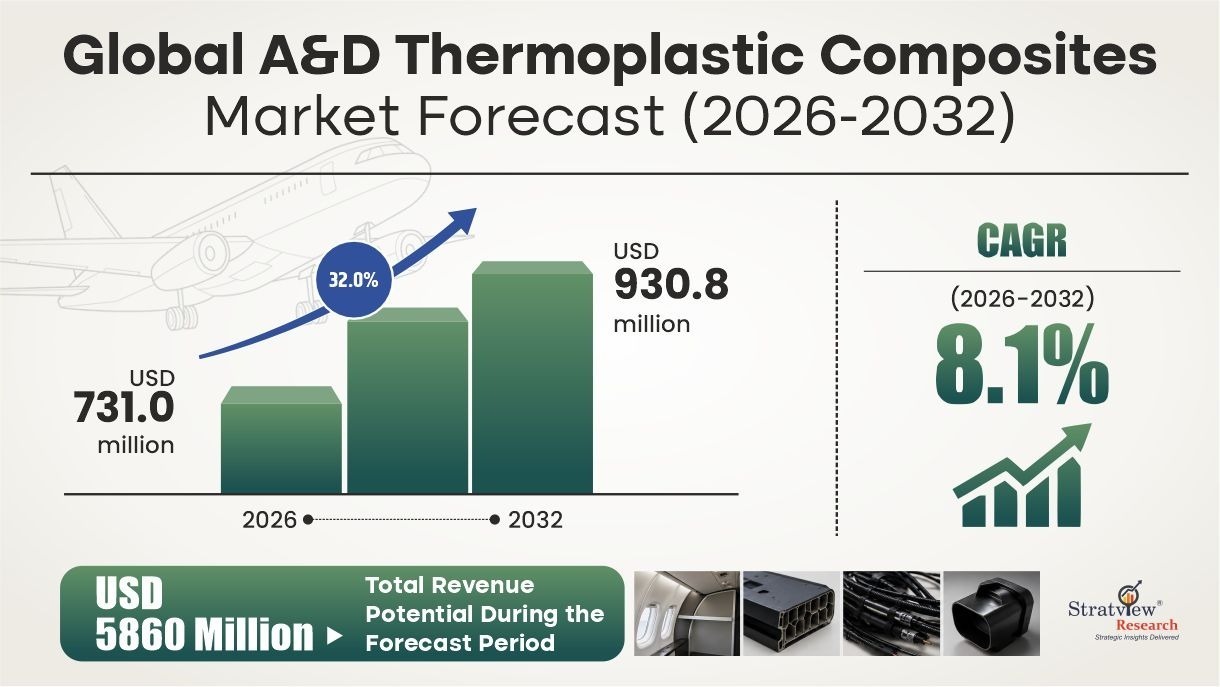
Stratview Research projects the global aerospace and defense thermoplastic composites market to grow from $554 million in 2025 to more than $930 million by 2032, representing an annual growth rate of more than 8%. While still a relatively small segment of the broader composites industry, this trajectory reflects growing confidence that TPCs will play an increasingly important role in the next generation of aircraft manufacturing.
As seen on Plasticstoday.com
Composights
Editorial
Newsletter
Subscribe for regular composites intelligence
The most trusted editorial picks and market signals on composites — straight to your inbox.