
If we do a quick recap of the top-tier international composite and aviation-related trade shows in 2022, we can easily conclude that eVTOLs stood out to be among the most talked-about innovations throughout those events. And though they’ve been the industry’s favorite thing to write about for a long time now, the fact that we are now able to see several of those full-scale demonstrators in a single event just gives us a really good idea about how close the anticipated Advanced Air Mobility(AAM) revolution is.
eVTOLs will be one exciting paradigm shift to witness in the mobility industry and according to the claims being made by the leading eVTOL OEMs, a few handpicked cities (cities with high traffic congestion and a supporting UAM infrastructure like Los Angeles, Miami, etc.) might be witnessing hundreds of them as soon as 2025.
Since it’s mobility that we are talking about and that too, electrically powered; lightweighting has to be among the key design requirements, and considering the formidable alliance that lightweighting has with advanced materials and composites, the eVTOL industry will be among the huge demand generators for composite materials in no time.
Composites Taking it to the Skies with eVTOLs
According to a recent report on eVTOLS by Stratview Research, yearly eVTOL production volumes would reach 5,000+ units by 2028, generating a demand for ~7.4 million kilograms of composite materials around the same time. Taking into account, the potential changes in the cost of carbon fibre, and resin, the demand thus generated in the year 2028 for composite materials, by the eVTOL industry is estimated to be worth $517 million in value.
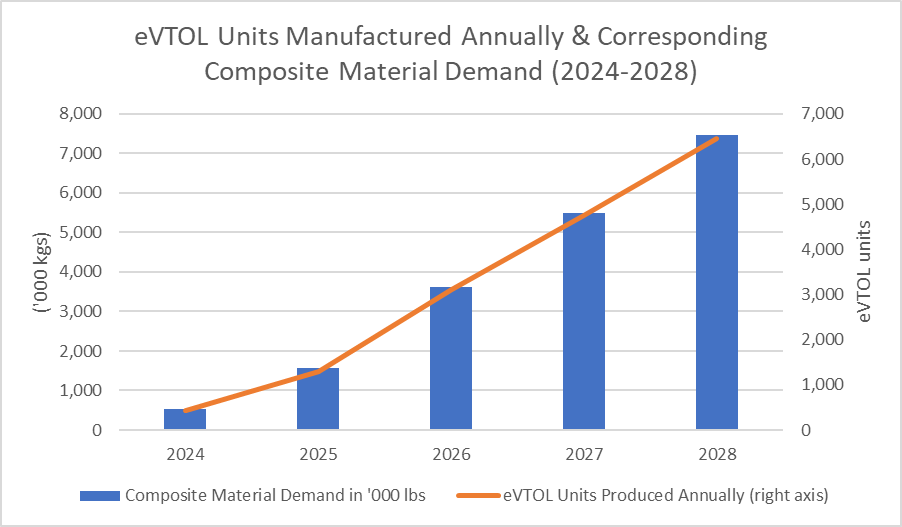
What must be noted here is, as per the disclosed information, Joby is running at least one step ahead of others in the certification race since it has already received the Means of Compliance from the FAA, and still has a commercialization target of 2025. On the other hand, some OEMs still don’t have their certification basis confirmed with the concerning regulatory authorities, which is the step before receiving the means of compliance; and yet they are planning to start commercialized operations in 2024. But, regardless of the year of entry into service, the demand for composite materials from the eVTOL industry will more than double every year during the initial 2-3 years of commercialization and it will happen primarily because of two factors.
All leading eVTOL OEMs are planning to scale their manufacturing volumes very rapidly, by a factor >2x every year, once they receive a nod from the regulatory authorities.
Though tentative, many leading OEMs have several hundreds of pre-orders in their respective order books.
Another factor contributing to the high demand for composite materials from this industry is the high penetration as compared to its allies in the transportation industry. For instance, the pioneers of composites usage in aircraft, namely the Boeing 787 and Airbus A350 XWB, are both ~50% composites by weight. For light vehicles, the percentage is generally <15% and for eVTOLs, even the lower range is higher than the higher range of other industries, i.e., 70%, and for some programs, it can go as high as >90%.
Some major applications of composites in eVTOLs are shown in the figure below.
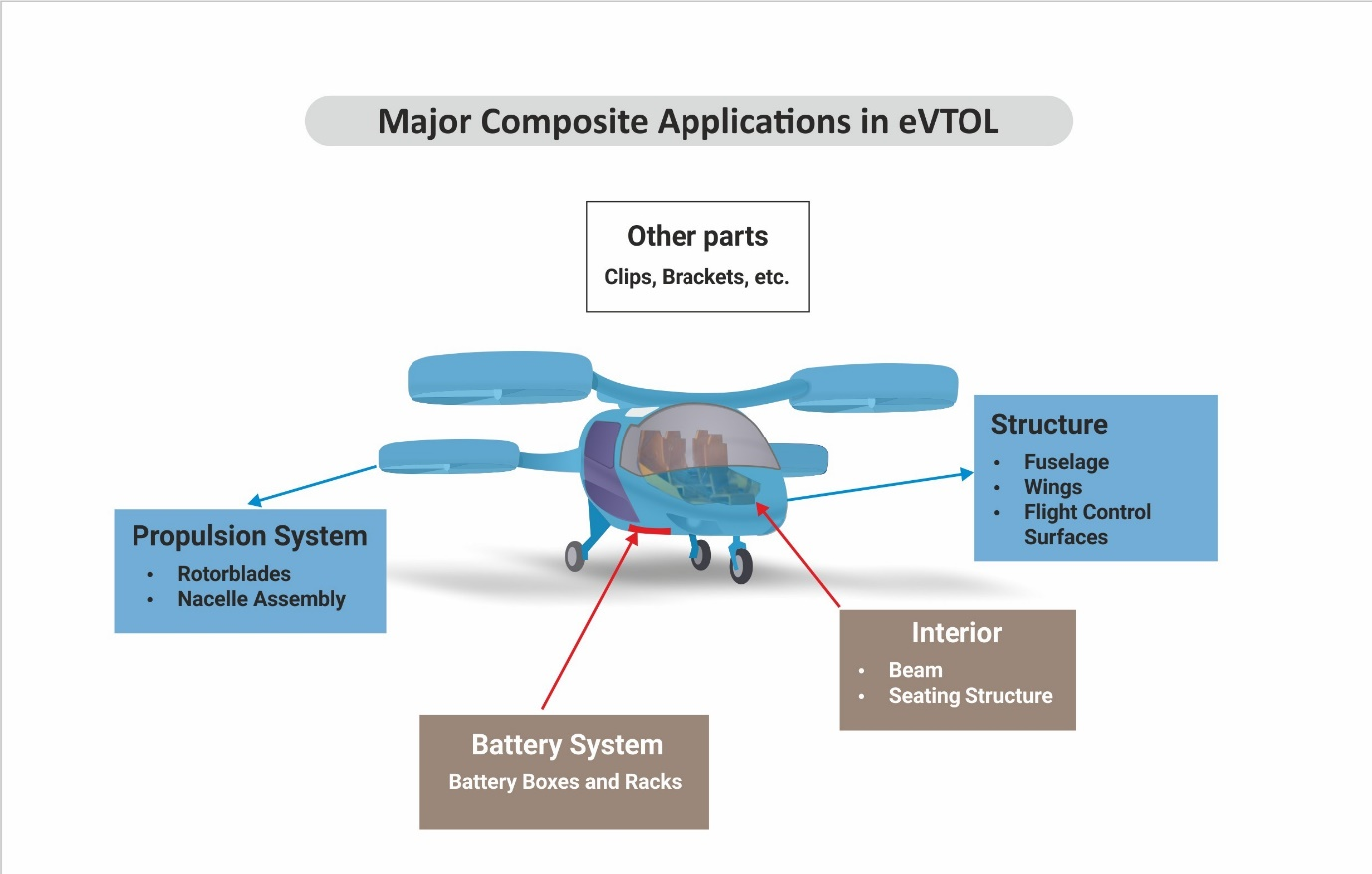
Structures and propulsion systems combinedly will consume about 75-80% of the composite materials used in these aircraft, with interior applications like floor panels, beams, etc. being second in line with an approximate share of 12-14%. The remaining share will belong to avionics and other smaller applications.
It’s no wonder that the cost breakdown for the manufacturing of eVTOLs, as suggested by leading OEMs, also follows a similar distribution. For example, according to the estimates by Vertical Aerospace, 40% of the manufacturing cost will be spent on battery and propulsion systems, followed by another 30% being spent on structures and interiors. Avionics will account for ~20% of the manufacturing cost and the rest will be the cost of assembly.
Quality of Aerospace but Size and Applications Closer to Automotive
The manufacturing/fabrication processes in case of eVTOL parts don’t hold a lot of surprises since the design requirements are more or less at par with the existing aviation standards and the expected performance parameters are also the same.
Just like aerospace, in the fabrication of primary structural parts like wings, fuselage, etc., prepreg materials will be used more heavily as compared to dry fabrics, together with vacuum bagging. One key enabler however, in case of eVTOL parts, for exploring new fabrication methods is the smaller dimension of the parts as compared to traditional aircraft. Because of the smaller dimensions of end parts, faster processes like compression molding will find more applications in eVTOLs as compared to conventional aircraft. Not to mention, for smaller, less complex parts requiring high-volume manufacturing like rotor blades, compression molding will be the preferred process.
For smaller and more complex parts like brackets that require high-resolution manufacturing, 3D printing can be employed since it is already finding sufficient applications in eVTOL prototyping.
Now coming to the volumes, the combined annual production volume, based on the individual manufacturing targets put forward by different leading OEMs, can be expected to surpass the 6,000 units mark within 5 years into commercialization. These are the kinds of volume that the automotive industry is more comfortable working with, rather than aerospace. Also, eVTOL as an application will claim almost its entire share from road-taxis, rather than conventional aircraft. Thus, it would be safe to describe eVTOLs as a common ground between aerospace and automotive, and Figure 3 presents a high-level comparison between all three:
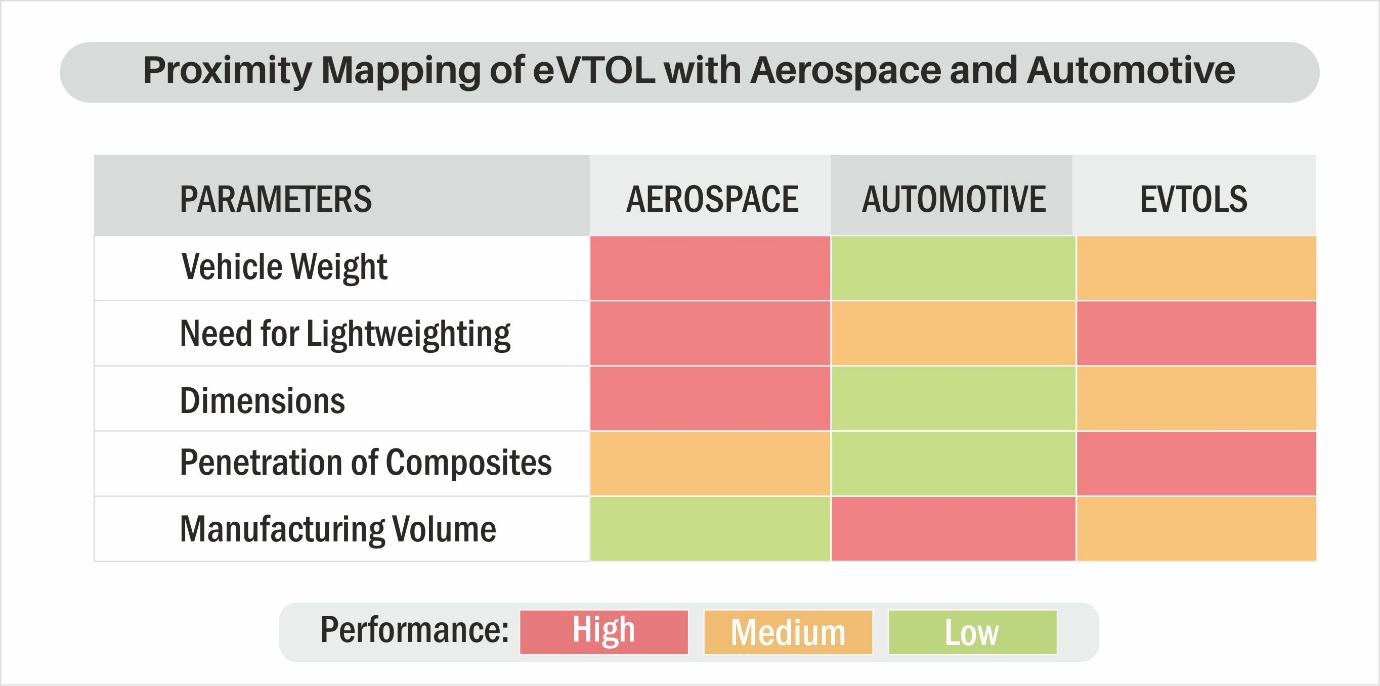
As a consequence, key players from the automotive supply chain are showing huge interest in this industry and have also formed long-term partnerships with the existing players. Porsche’s partnership with Embraer’s subsidiary Eve Air Mobility, Toyota’s partnership with Joby, Lilium’s partnership with Denso, Archer Aviation’s partnership with Stellantis, etc. are but some examples of the automotive-eVTOL synergy. The interest of the automotive industry isn’t however just limited to partnerships. Key automotive OEMs like Honda and Hyundai have come up with their own eVTOL programs as well.
The overlapping interests between the eVTOL and the automotive industry will likely open up more cross-industrial opportunities in the coming time.
The Checklist for Material Selection: Recyclability, Mass Production Compatibility, and Ease of Certification
Being the aerospace industry’s ‘go-to’ material, more than 90% of the composites used in eVTOLs would be carbon fibre, infused with epoxy. From a design point of view, this is because carbon fibre has the highest specific stiffness of any commercially available fibre and it perfectly fulfils all the mechanical requirements like lightweight, high strength-to-weight ratio, impact resistance, etc. On the other hand, from a strategic point of view, this is because almost every eVTOL OEM is planning to pass the certification process as smoothly as possible, without experimenting much with the tried and tested materials.
The same approach can be seen on the matrix level too, where again, more than 95% of the leading players are aiming for thermoset-rich models since the regulatory authorities are more familiar with thermosets and it will ease up the certification process for them a bit. According to Stratview Research, of the overall demand for composite materials from the eVTOL industry, thermoplastics will likely have a single-digit share of the demand till 2030.
What many experts from the aerospace and the composites industry also told Stratview Research during some recent one-on-one interviews is that choosing to stick to thermosets instead of thermoplastics is fine as long as they are able to keep the manufacturing volume within a few thousand aircraft annually. But once the production scales up (which, according to the OEMs, will happen in the next five years), the OEMs will either have to introduce new thermoplastic-rich models or they’ll have to modify their existing thermoset-rich models to thermoplastic-rich ones. In either case, they’ll have to knock on the doors of the regulatory authorities once again.
Currently, among the visible eVTOL OEMs, Texas-based Jaunt Air Mobility is the only one working on a thermoplastic-rich model and in fact, on their company’s website, Jaunt Air mentions ‘99% recyclable’ as one of the specifications of its eVTOL.
For eVTOLs, recyclability becomes all the more important because of its not-so-long (15-20 years) product cycle. If the industry keeps producing thousands of eVTOLs for the next 5-10 years and they all start becoming obsolete after a service period of ~20 years, the industry will have piles of composites to take care of.
Potential Turbulence for eVTOLs
Some major factors that could further delay the take-off of the eVTOL industry, are:
Shortage of manufacturing capacity:
The aerospace industry is expected to be back at its full capacity by 2025, making full utilization of the available manufacturing capacity for itself. Under such a scenario, if the industry is faced with a new vertical altogether, with yearly production volumes of a few thousand, a shortage of production capacity can take place. The targeted production volumes also make the integration of automated production lines, inevitable for the OEMs.Shortage of Raw Materials:
At the end of the 24th annual Carbon Fibre conference, held in November 2021, industry consultants Tony Roberts, principal of AJR Consultant (Lake Elsinore, California), and Dan Pichler, director, carbon fibre, at carbon fibre manufacturer AKSA Akrilik Kimya Sanayii A.S. (Istanbul, Turkey) estimated a potential shortfall of 55, 250 metric tons of carbon fibre in 2026, with all supporting figures. According to them, the deficiency could start appearing as soon as 2023. Now, for vehicles that are >70% composites, such a shortage would mean delayed deliveries, and hence, a huge loss of revenue.Lack of UAM-supporting Infrastructure: The lack of UAM-supporting infrastructure will largely limit the no. of cities to which it can be expanded. Currently, there are fewer than a hundred cities worldwide that are ready to support UAM. Los Angeles, Miami, New York, Dallas, Paris, Berlin, Rome, Munich, Madrid, Shanghai, Seoul, Tokyo, etc. are among the top target cities of every eVTOL fleet owner.
Community Acceptance: Apart from manufacturing capacity, supply chain constraints, and delays in certification, the most crucial factor that would determine the success of eVTOLs, would be community acceptance. This will include various factors starting from the willingness of the population to spend, to the noise footprint left by eVTOLs. This is why OEMs and fleet owners are trying to keep the cost per mile as much within the affordable range as possible. OEMs like Joby, Lilium, Vertical Aerospace, etc, are all suggesting a cost/mile of <$5.
What the Future Would Look Like for This New Vertical?
The opportunities associated with eVTOLs might arrive a bit later than the currently projected timeline and that would be majorly because of the uncertain delay in receiving the appropriate certificates from the regulatory authorities. Everything else, starting from pre-orders, UAM infrastructure development, test flights, full-scale demonstrations, and the excitement among the public, is right on track.
So, while there might be some initial delay in the take-off, when the UAM revolution finally arrives, it will be an exciting one to witness.

Composights
Editorial Team
Newsletter
Subscribe for regular composites intelligence
The most trusted editorial picks and market signals on composites — straight to your inbox.